
Highlights from the 2026 AAHA Oncology Guidelines
What the 2026 AAHA Oncology Guidelines Mean for Your Practice
Cancer remains the leading cause of death in our canine and feline patients, with roughly 1 in 4 dogs and 1 in 5 cats diagnosed in their lifetime. By age 10, those numbers climb to about 50% of dogs and 30% of cats. The 2026 AAHA Oncology Guidelines reflect how rapidly the field is evolving, with a growing arsenal of evidence-based systemic and localized therapies, emerging diagnostics that warrant cautious optimism, and a renewed emphasis on GP-specialist collaboration as central to quality care.
Below is a clinician-focused summary of the updates most likely to change how you work up, treat, and co-manage oncology cases.
Diagnosis Is the Beginning, Not the End
The guidelines reiterate a principle worth restating: suspicion or diagnosis of cancer is the start of the diagnostic process, not the finish line. An optimal treatment plan still requires cytologic or histopathologic confirmation, and when in-house evaluation is equivocal, pathologist review is the standard. Staging should be tailored to tumor type, patient need, and client priorities rather than applied as a one-size-fits-all panel.
Core staging components remain familiar: CBC, chemistry, urinalysis, retroviral testing in cats, regional lymph node cytology, thoracic radiographs, abdominal ultrasound, and advanced imaging (CT or MRI) when clinically indicated. IHC, flow cytometry, and PARR continue to add diagnostic and prognostic value for lymphoid neoplasia.
Newer Diagnostics: Promise With Caveats
Two categories are getting significant attention and significant marketing:
Liquid biopsy. Blood or urine-based assays designed to detect, screen for, or monitor cancer.
Personalized or precision medicine profiles. Blood or tumor samples used to identify treatments a tumor may be most susceptible to based on its genome rather than histopathology.
The guidelines flag an important caution: these tools hold promise, but there is currently insufficient evidence that they improve patient outcomes. Compounding this, minimal to no regulatory approval process exists for veterinary cancer diagnostics and medical devices, which means a product can be marketed without demonstrating accuracy or benefit. Critical appraisal of peer-reviewed evidence, not marketing material, should drive adoption decisions.
Conditional Licensure: What It Actually Means
Several newer therapeutics are available under FDA conditional licensure, a regulatory pathway that requires demonstrated safety and a "reasonable expectation of effectiveness" when used according to label. A few points worth keeping in mind:
Conditionally licensed products must be used on-label. Extralabel use is a federal violation.
Manufacturers have up to five years to demonstrate full effectiveness. Products that cannot meet that bar are withdrawn.
The FDA regulates chemical-based drugs. The USDA regulates biologics such as vaccines and monoclonal antibodies, and efficacy data for biologics is typically less extensive than for FDA-approved drugs. The Oncept melanoma vaccine is a familiar example.
Newer Systemic Therapies
Rabacfosadine (Tanovea). A double prodrug nucleotide analog that inhibits DNA synthesis via DNA polymerase inhibition. Administered IV over 30 minutes every three weeks for up to five doses. Primary indication is naive or relapsed canine lymphoma, with early data suggesting promise in canine multiple myeloma. Main toxicities are neutropenia and GI upset; less commonly, cutaneous reactions and pulmonary fibrosis. Full FDA approval.
Verdinexor (Laverdia). A selective inhibitor of nuclear export, administered orally by owners twice weekly with a mandatory 72-hour interval between doses. Side effects include GI upset and myelosuppression, with rare severe reactions. Conditional licensure for canine lymphoma.
Crofelemer-CA1 (Canalevia-CA1). An oral antidiarrheal indicated for chemotherapy-induced diarrhea, working by regulating chloride and water secretion in the GI tract. Conditional licensure.
Gilvetmab. A caninized anti-PD-1 monoclonal antibody that enhances immune-mediated tumor killing. Administered IV over 30 minutes every other week for up to 10 treatments. Conditional licensure for mast cell tumors and melanomas, available only through veterinary oncology specialists.
Cell therapies and autologous cancer vaccines. Adoptive cell therapy, ELIAS cancer immunotherapy, CAR T-cell therapy, and tumor-tissue-derived autologous vaccines (e.g., Torigen) represent genuinely exciting directions. Evidence supporting routine clinical use remains limited, and further research is needed before these become standard of care.
Newer Localized Therapies
Tigilanol tiglate (Stelfonta). FDA-approved intratumoral therapy for non-metastatic canine mast cell tumors. Cutaneous tumors can be located anywhere on the body; subcutaneous tumors must be below the elbow or hock. Restrictions apply to tumor size and total dose. The injection produces hemorrhagic tumor necrosis, leaving a wound that typically heals within 4 to 8 weeks.
Electrochemotherapy (ECT). A specialized unit generates an electrical field that transiently increases cancer cell membrane permeability, enhancing intratumoral chemotherapeutic efficacy. A growing area for local tumor control, still under active research.
Treatment Principles Worth Re-emphasizing
The guidelines reinforce several principles experienced clinicians already know but that are worth keeping front of mind:
Treatment is frequently multimodal. Surgery, chemotherapy (conventional MTD or metronomic), radiation, immunotherapy, TKIs (toceranib remains the only FDA-approved veterinary TKI), nutritional support, and pain management each have a role.
The first surgery is the best surgery. Recurrent tumors are more invasive and harder to fully excise. Marginal excision should be avoided when possible. Fascial planes are reasonable deep margins; fat is not a barrier, and a pseudocapsule typically represents compressed tumor cells rather than true containment.
Submit masses in their entirety for histopathology and margin analysis whenever feasible.
Neutropenia remains the dose-limiting toxicity in veterinary oncology. Febrile neutropenic patients warrant hospitalization, IV fluids, broad-spectrum antibiotics, and supportive care. Afebrile, clinically well neutropenic patients may be managed with oral antibiotics and close monitoring.
Radiation side effects fall into acute (2 weeks to 2 to 3 months post-treatment, generally self-limiting) and late (months to years later, potentially irreversible) categories. Counseling owners about late effects, including leukotrichia, permanent alopecia, cataracts, necrosis, and radiation-induced secondary malignancies, is part of informed consent.
Response Assessment: A Shared Vocabulary
Consistent terminology matters when co-managing patients with specialists:
Complete remission (CR): regression of all evidence of disease with normal-sized lymph nodes.
Partial remission (PR): greater than 30% reduction in the sum of the longest diameters of target lesions (up to 5 lesions), with no new lesions.
Progressive disease (PD): at least 20% increase in the sum of longest diameters, or appearance of new lesions.
Stable disease (SD): neither sufficient shrinkage for PR nor sufficient progression for PD.
Safe Handling of Hazardous Drugs
USP 800 standards apply. Human healthcare data has shown increased rates of reproductive complications, fetal loss, DNA alterations, and malignancy in personnel handling hazardous drugs, and we owe our teams the same level of protection.
Key points:
Minimum PPE: double chemotherapy gloves, single-use impermeable gown, eye protection, and mask. A closed system transfer device is strongly recommended for drawing up and administering chemotherapy.
A spill kit should be readily accessible anywhere hazardous drugs are used.
Never break, crush, or compound chemotherapy tablets into liquid formulations due to exposure risk.
Always use a double-check system for dose calculations.
For 72 hours post-treatment, urine, feces, vomit, and saliva should be handled with gloves and a mask. Immunocompromised individuals and pregnant women should avoid contact entirely.
Client education on at-home handling is not optional. It is both an ethical and legal obligation.
Vaccination in Oncology Patients
Current literature does not support a single consensus recommendation. Decisions should be individualized based on tumor type, treatment protocol, and patient status. When in doubt, a specialist consultation can help tailor recommendations for the specific patient in front of you.
Collaboration Is the Standard of Care
One of the most clinically meaningful themes in the 2026 guidelines is the explicit recognition that collaboration between general practitioners and veterinary oncologists improves both patient care and client engagement. Providing a consistent, informed space for conversations about diagnosis, prognosis, and treatment expectations keeps the whole care team aligned and supports clients through decisions that are often emotionally and financially complex.
The guidelines also explicitly acknowledge veterinary telehealth as a versatile tool for improving access to specialty care, particularly in regions where in-person specialty services are limited or waitlists are long.
How DVM STAT Supports Oncology Cases
DVM STAT connects general practitioners, ER doctors, and urgent care clinicians with board-certified oncologists and other specialists for real-time teleconsultation. Whether you need help interpreting a challenging cytology, building a staging and treatment plan, navigating conditional licensure decisions, or talking through prognosis with a client, a specialist is available when you need one.
Reference: 2026 AAHA Oncology Guidelines for Dogs and Cats
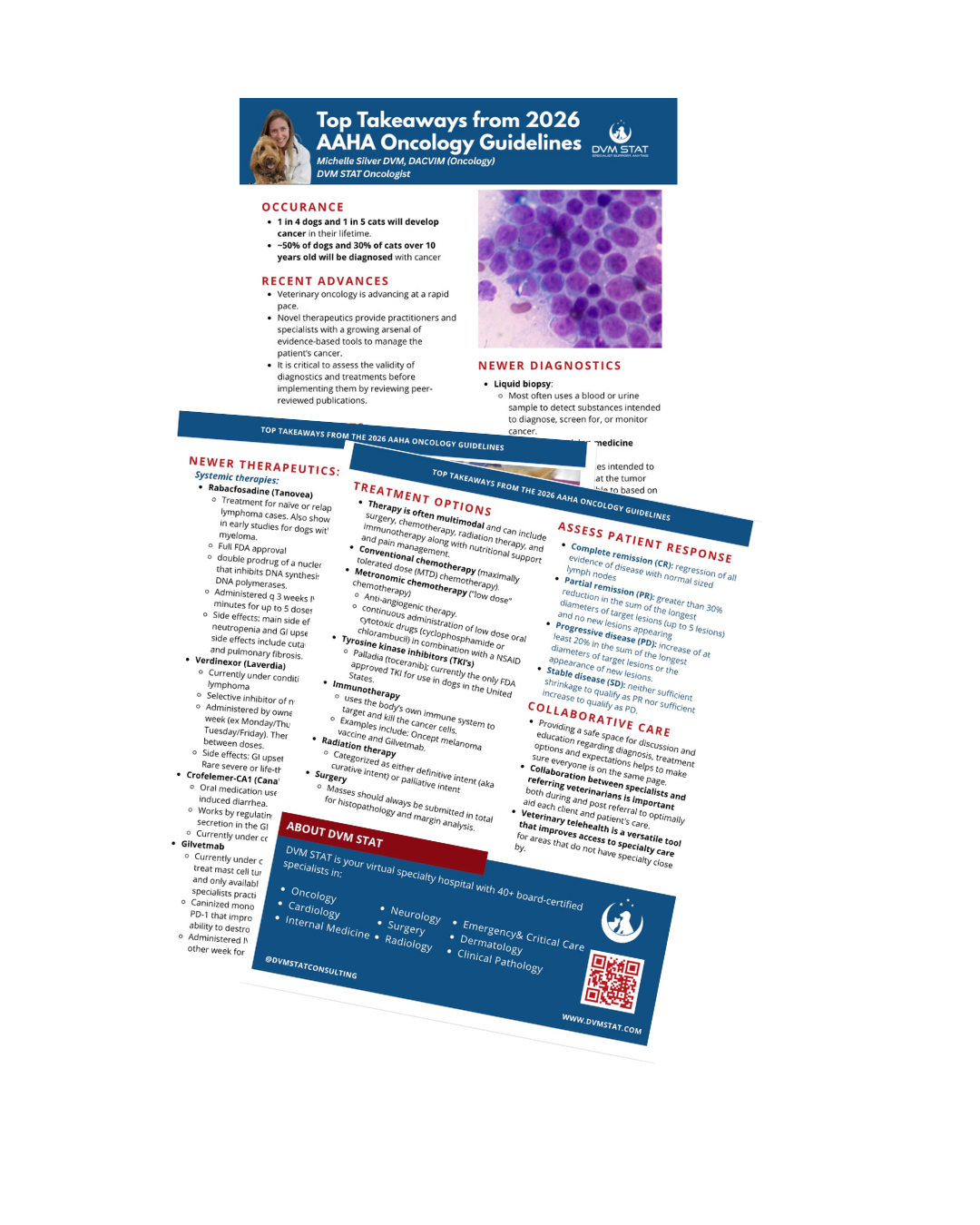
Want the quick-reference version of this blog? Download our Top Takeaways from the 2026 AAHA Oncology Guidelines one-pager to keep on hand in your practice.
Download Top Takeaways from the 2026 AAHA Oncology Guidelines