
Get More From Every Specialty Teleconsult
What to send so every case comes back faster, more detailed, and tailored to your patient
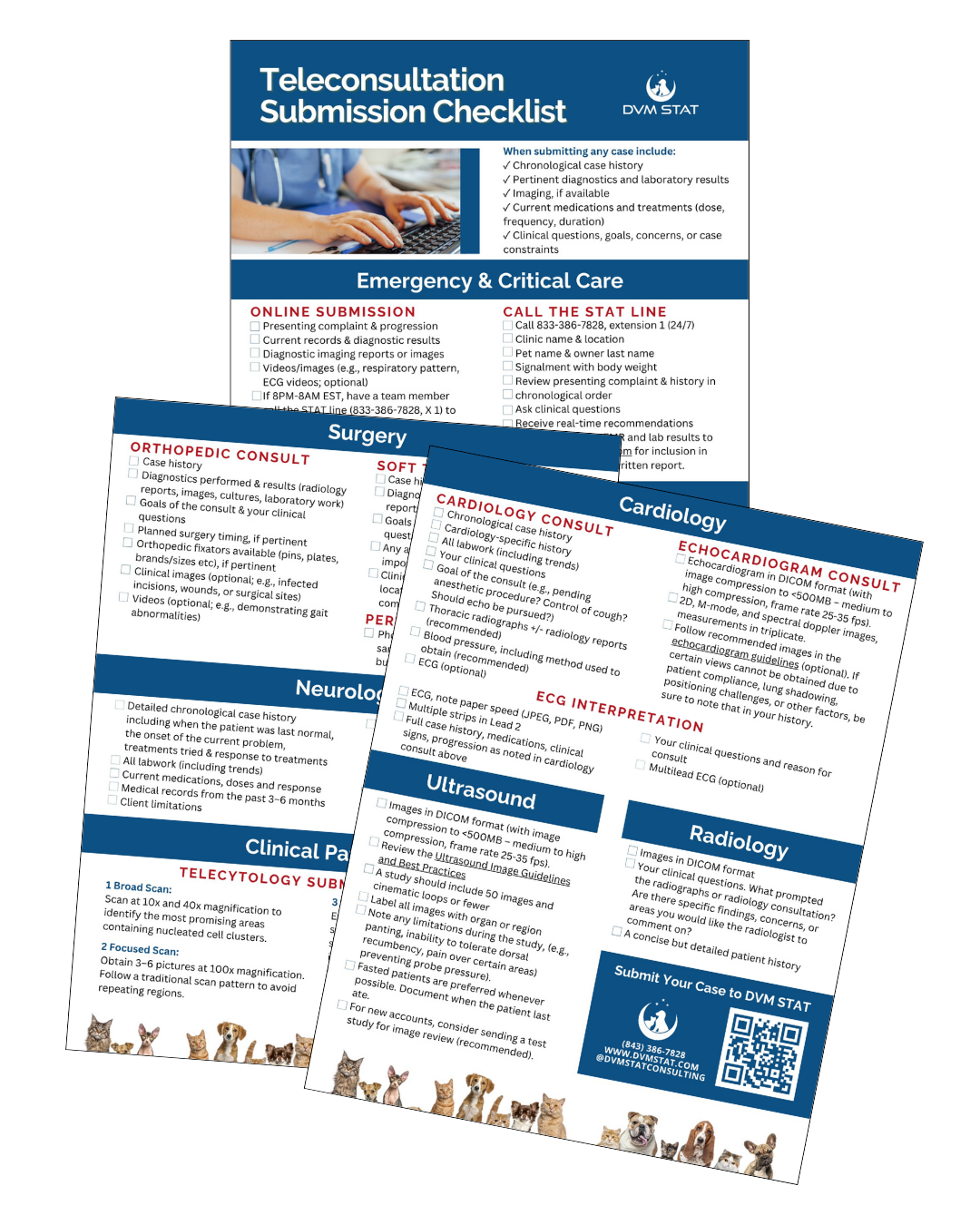
A teleconsultation keeps more cases in-house, backs up your clinicians on the complex ones, strengthens client confidence in your plan, and maximizes your in-house diagnostics.
What separates a consult that comes back fast and detailed from one that comes back with a list of follow-up questions is not how extensive your workup is. It is knowing which few submission details matter.
Here is exactly what to send so you get the most from every case you submit, whatever the specialty.
Be sure to download a free checklist everything you need to submit for each specialty at end of the blog.
Every consult needs these fundamentals
For most cases, you need to submit:
Medical records. For internal medicine, cardiology, dermatology, oncology, emergency and critical care, and neurology, we review up to 3 to 6 months of medical records.
Chronological case history. When the patient was last normal, the onset, and the clinical course since. This is typed into the case submission.
Pertinent diagnostics and lab results, with trends wherever you have them.
Imaging, when it is pertinent to the case, such as cardiology or diagnostic imaging submissions. Radiology reports can be included for other services as part of the pertinent diagnostics.
Current medications and treatments, including dose, frequency, duration, and response.
Each specialty also has a few unique requirements of its own. We've outlined those in a free downloadable checklist that covers the additional information most helpful for each individual service. You'll find it at the bottom of this page.
And don't worry about submitting perfect records. Submit what you have. If additional information is needed, your specialist will let you know.
How to get even more from your consult
After more than 20,000 consults, our specialists say two things do the most to ensure a customized, timely, and detailed consultation that actually answers your clinical questions:
Include your clinical questions, goals, concerns, and any case constraints.
Review our checklist for the specialty-specific submission recommendations.
Questions, goals, concerns, and constraints
Picture two submissions for the same patient. One says "any thoughts?" The other says, "I have an anesthetic procedure scheduled Friday, the owner has declined referral, and I need to know whether this murmur changes my plan." The second one tells us what decision you are trying to make, so the report comes back aimed at that decision instead of covering everything in general terms. That is the difference these four details make.
Questions. Your questions are what make the recommendations specific to your case. They are not copied into the report. They are answered directly in the body of the consultation, so ask away. See below for common questions we receive, by specialty.
Goals. As clinicians, we practice within a spectrum of care, and your client's goals shape the case. You know the case the best. When you include both your goals and the client's diagnostic or treatment goals, the consult comes back tailored to your actual scenario. Maybe there is an anesthetic procedure coming up. Maybe a certain diagnostic is off the table because of cost. Maybe a medication is not an option for the owner. Those details let your specialist build the recommendation around what is realistic for this patient and this client.
Clinical concerns. You have familiarity with the case and clinical context and a lot of the subtle details never make it into the record. Your clinical impressions are an important part of the consult data. They help the specialist reach the most complete and accurate assessment and recommendations, so share what you are seeing and what is giving you pause.
Constraints. Note any client limitations up front. For example, financial limits, an owner who cannot give twice-daily injections, or a fractious patient that cannot be reliably pilled. Knowing the constraints keeps the plan grounded in what your team can actually carry out.
Specialty-specific clinical questions
Not sure what to ask? Here are examples of the kinds of questions that lead to a focused, useful report:
Cardiology: Pending anesthetic procedure? Control of a cough? Should an echo be pursued?
Internal Medicine: Is this chronic GI case pointing toward protein-losing enteropathy or something else? What is the most cost-effective next step for this PU/PD? Can these liver values be monitored, or do additional diagnostics need to be pursued now?
Neurology: Where does this localize? Is this medical or surgical? Is advanced imaging warranted, or is a treatment trial reasonable first?
Oncology: What staging makes sense before I refer? Which protocol fits this client's budget and goals? Is palliative care a reasonable path here? Can I safely treat in my clinic?
Emergency and Critical Care: Is this patient stable enough to manage overnight, or do they need transfer? I don’t have X medication so what should my fluid and pressor plan for this shock case be? How do I manage this toxicity until I can transfer it in the morning?
Radiology: Does this pulmonary pattern fit my clinical suspicion? Is this a true lesion or positioning artifact? Is surgery indicated? What imaging should come next?
Surgery: Is this surgery something I can pursue in-house, or should it be referred? What approach and/or implants are indicated in this case? What margins should I get? Do I need to have blood products available at the time of surgery?
Clinical Pathology: Is this inflammation or neoplasia? Should I go ahead and biopsy? Should I FNA regional lymph nodes too?
Specialty-specific specifics
Beyond the fundamentals, each service has a few specifics that make a real difference. Some are essential for that specialty, others are simply helpful when you have them.
We created a free checklist so you know at a glance what is worth tracking down before you submit and what is optional. You do not need every line to submit a case. These few items, though, do the most to improve the quality and speed of your consult:
Emergency and Critical Care. Send your records to consults@dvmstat.com before the consult so we can review them in real time.
Imaging consults (radiology, ultrasound, echocardiogram). Send images in DICOM, compressed appropriately (under 500MB, frame rate 25 to 35 fps), and labeled by organ or region. Note any study limitations up front, such as panting, positioning, or patient compliance. Wrong format or unlabeled studies are one of the most common causes of delay, because we have to request a re-send before we can begin. Also make sure the number of images you submit matches the number you list in your submission. A discrepancy triggers a call to your clinic to clarify before the case can be read.
Cardiology and echocardiogram. Measurements in triplicate, blood pressure with the method used to obtain it, and thoracic radiographs give the cardiologist a full clinical picture.
Neurology. Video does what text cannot. A clip of the gait, the patient orienting in a room, or your neuro exam often localizes the lesion faster than a written description. If you are not entirely sure what you are seeing, include the video anyway so the neurologist can see what you are seeing. A fill-in neurology exam form is available to download and submit with your case, which takes the pressure off remembering every component of a full neuro exam.
Surgery. Planned surgical timing, diagnostics already performed, available fixators and equipment, and your specific goals let the surgeon tailor the plan to what you can actually do in your clinic. For postoperative consults, include clinical images, cytology, or any other pertinent details.
Clinical Pathology (telecytology). Keep it simple and follow the scan protocol: a broad scan at 10x and 40x to find your fields, three to six focused images at 100x, and files labeled clearly by site.
VHMA members: your first consult is 50% off
If your practice is a member of the Veterinary Hospital Managers Association, your first DVM STAT consult is 50% off. It is the simplest way to put specialist input to work on a real case and show your team how quick and straightforward the process actually is.
Final thoughts
The most successful teleconsultations aren't necessarily the ones with the most diagnostics, the longest records, or the most complete workups. They are the ones where the veterinarian provides enough clinical context for the specialist to understand the case, answer your questions, and help determine the next best diagnostic and therapeutic steps.
Remember, you don't need perfect records or every diagnostic result before reaching out.
Start with the fundamentals, include any specialty-specific information you have available as well as your goals and questions about the case, then submit. If additional information is needed, your specialist will let you know.
Our goal is to help you access specialist expertise quickly, efficiently, and in a way that supports both your patient and your practice.
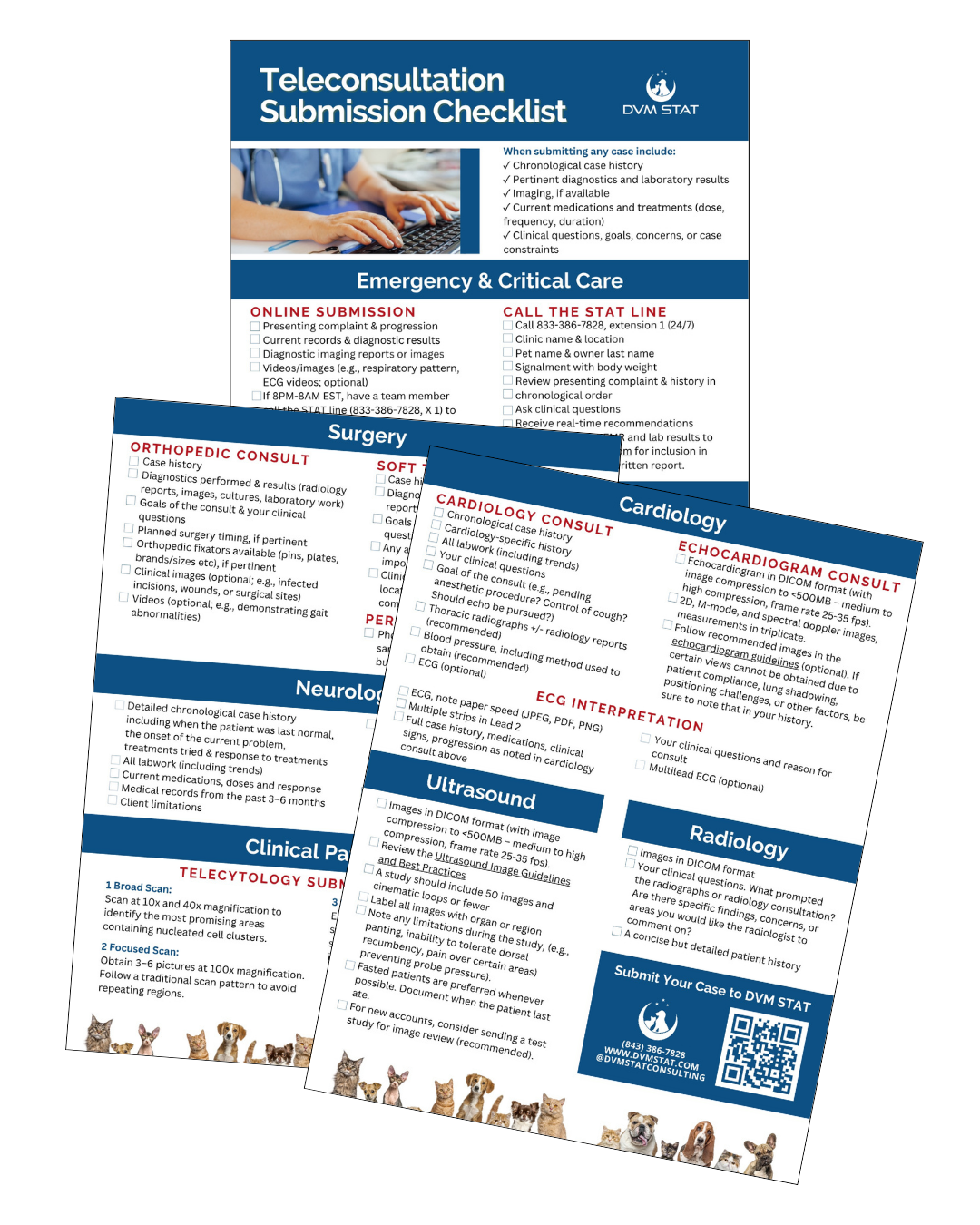
Download the Teleconsultation Submission Checklist (free)
Need a quick reference guide for your team? Download our free Teleconsultation Submission Checklist, which summarizes the essential and helpful information to submit for every DVM STAT specialty service.
✔ Emergency & Critical Care ✔ Cardiology & Echocardiography ✔ Internal Medicine ✔ Neurology ✔ Dermatology ✔ Radiology & Ultrasound ✔ Surgery ✔ Clinical Pathology
Download the checklist here:
-
Specialty Service Details: Emergency & Critical Care, Cardiology, Internal Medicine,Neurology, Oncology, Dermatology, Radiology, Ultrasound, Surgery, Clinical Pathology
Echocardiogram Imaging Recommendations & Compression Guidelines (download)
Abdominal Ultrasound Protocol & Compression Guidelines (download)
Need help introducing teleconsults to clients or promoting the service at your clinic? Download the free teleconsultation marketing templates for veterinary clinics
VHMA Members Receive 50% off their 1st DVM STAT Teleconsultation. Claim your 50% discount
Practice owners and managers need solutions that support both patient care and hospital operations. DVM STAT does both without hiring or referral delays. Learn more.